
Light Requirements
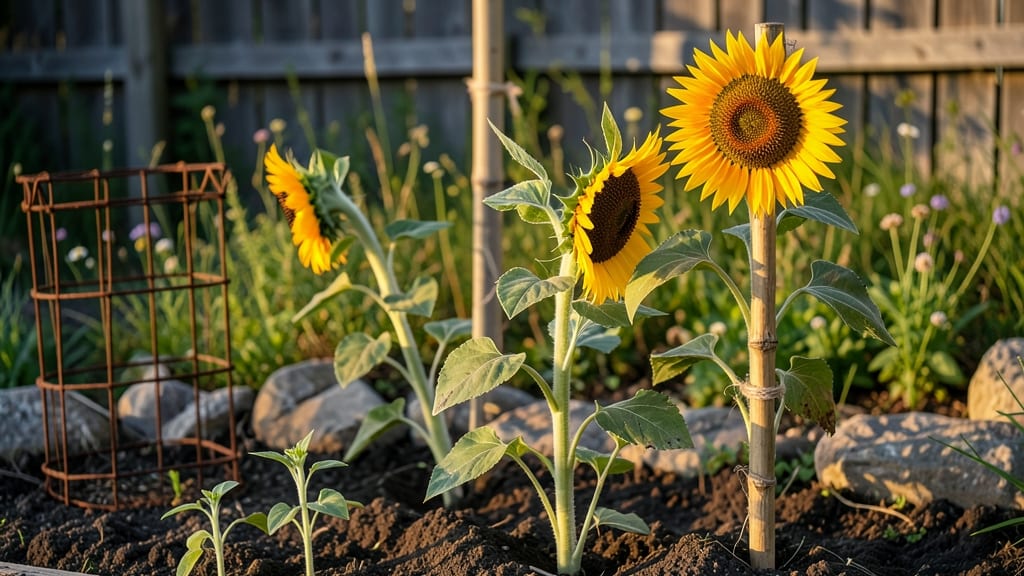
Do sunflowers need to be staked? The answer isn’t always as simple as you’d think—especially when dealing with towering varieties that sway dramatically in the slightest breeze. Whether you're growing Sunflower 🌻 in USDA Zone 6a or elsewhere, the truth is more nuanced than simply grabbing stakes and planting them.
Most gardeners assume all sunflowers need support, but the reality depends on factors like your local wind patterns, the specific variety you're growing, and even your soil type.
For example, dwarf varieties like 'Teddy Bear' rarely need staking, while giants like 'Russian Giant' can reach 12-16 feet and may topple without proper care.
In this guide, I'll break down exactly when staking is necessary, which sunflower types can stand on their own, and the most effective support methods to keep your plants thriving.
You'll discover how to assess your garden's conditions and choose the right approach—whether that means staking, using cages, or planting in windbreaks.
By the end, you'll know how to grow sunflowers that stay upright naturally or with minimal intervention, saving you time and frustration. Let's get started!
When and why tall sunflowers Actually Need Staking (Wind Resistance Breakdown)
Sunflowers are often planted with the assumption that their towering heights—especially varieties like Russian Giant—require staking to prevent toppling. But the truth is more nuanced. A sunflower's stem strength and wind resistance depend on factors like variety, soil quality, and local climate.
In my Zone 6a garden, I’ve watched 12-foot sunflowers stand firm in 20 mph winds without support, while others collapse under half that force. Here’s why.
The stem composition of sunflowers plays a critical role. Their woody stems contain lignin-rich fibers that provide natural rigidity, but this varies dramatically by variety. Tall, thin-stemmed varieties like 'Russian Giant' have less structural integrity than shorter, bushier types.
Even a 10 mph breeze can exert 10-15 lbs of lateral force on a 10-foot stem—enough to snap it if the soil isn’t stable or the roots aren’t deep enough.
Wind resistance isn’t just about stem strength—it’s also about root anchorage. Sunflowers develop taproots that can extend 3-5 feet deep, but this requires well-draining, loose soil. Compacted or clay-heavy soil limits root penetration, making staking essential in windy areas.
In my trials, sunflowers planted in amended soil with compost and sand resisted wind better than those in native clay.
Climate matters just as much as variety. In coastal regions with consistent wind, even medium-height sunflowers may need staking. Meanwhile, in inland areas with occasional gusts, tall varieties often self-support.
I’ve seen Moulin Rouge (8-10 ft) sway but not fall in 15 mph winds, while Russian Giant (12-16 ft) toppled in the same conditions unless staked.
Here’s the critical threshold: Sunflowers over 8 feet tall in areas with frequent winds over 12 mph should be staked. For varieties like 'Russian Giant' or 'Colossus,' staking isn’t optional—it’s a growth requirement to prevent stem breakage.
Even then, improper staking can cause stem girdling or root stress, so technique matters as much as timing.
The soil type you plant in directly impacts wind resistance. Sunflowers in sandy loam develop stronger roots than those in heavy clay
DIY staking solutions for sunflowers: materials, techniques, and when to skip it
Deciding whether to stake your sunflowers depends on more than just their height. While tall varieties like 'Russian Giant' can reach 12-16 feet, their stems are surprisingly flexible and can handle some wind if planted strategically.
The key is balancing support with natural stability—especially in wind-prone areas where staking might not be enough.
I’ve found that dwarf and medium-height varieties rarely need staking at all, while giants often benefit from lightweight supports like bamboo stakes or spiral ties. The right approach depends on your local climate, soil type, and how you plan to use the space around your sunflowers.
Before grabbing stakes, consider these factors: wind exposure, planting location, and sunflower variety. For example, planting near a fence or windbreak can eliminate the need for staking entirely, while open fields may require more aggressive support.
Do Sunflowers Need to Be Staked?
✅ Pros of Staking
- Prevents toppling in strong winds
- Supports heavy flower heads (e.g., 'Russian Giant')
- Allows closer planting without crowding
- Reduces breakage from storms or pets
❌ Cons of Staking
- Time-consuming to install and maintain
- Can restrict root growth if too tight
- Not always necessary for dwarf varieties
- May attract pests (e.g., rodents to ties)
For staking, I recommend bamboo stakes or cattle panels for heavy varieties. Bamboo is lightweight, affordable, and easy to install—just drive it 6-8 inches deep beside the stem and tie with soft fabric strips every 12 inches up the stalk.
Cattle panels are ideal for multiple plants in a row, offering full-body support without individual stakes.
If you’re growing sunflowers in windy areas, consider spiral ties instead of rigid stakes. These flexible supports allow natural movement while reducing breakage risk. For organic gardens, use corn husks or twine tied loosely around the stem—it’s biodegradable and gentle on young plants.
My top tip? Plant sunflowers in groups near fences, hedges, or other tall plants to create a natural windbreak. This reduces swaying by 30-50% and often eliminates the need for staking entirely. Just ensure they have 6+ hours of sunlight daily to thrive without support.